
The Input Channel
Everyone holds the same AI model. What separates a sharp answer from a confident wrong one is the input you feed it — and the human who holds the whole picture.
The model is a commodity. The input is the craft.
The Discovery Factory made one argument: when you build a predictive model, the bottleneck is the signals, not the model. This piece goes deeper into that same input — not the signals you feed a model you build, but the input you hand an AI you collaborate with: how it’s structured, what survives the trip through the model, and why the same input lands differently for everyone.
You, your competitor, and a stranger across the world can open the same frontier model in the same minute. The weights are identical. So the model cannot be what separates a good answer from a bad one.
What separates them is the input — what reaches the model, with what context, at what moment — and the predictable ways the model narrows it on the way through. The model isn’t weak. It’s mis-fed.
The Whole Channel in One Picture
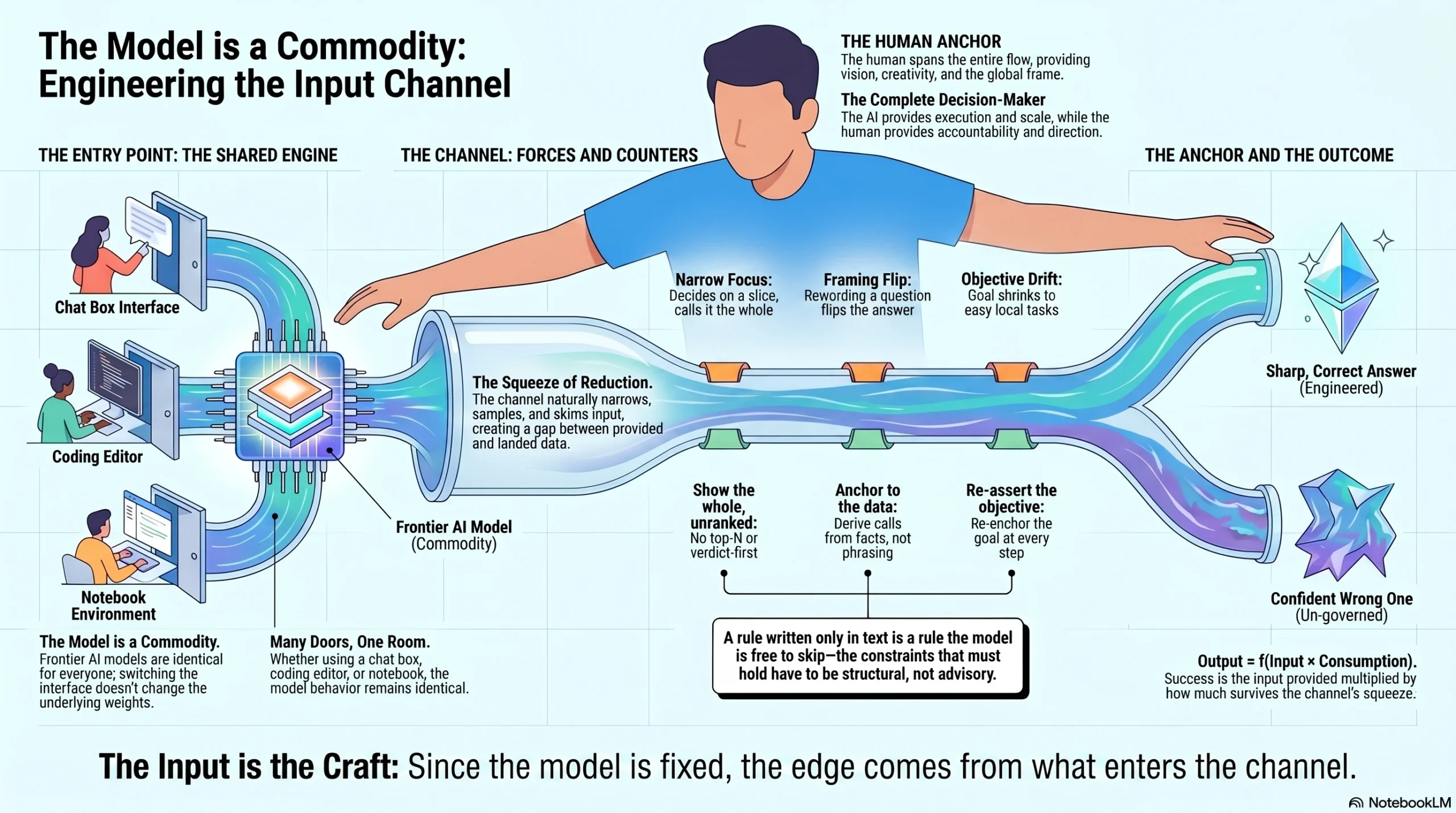
The same commodity model entered through any door, the input squeezed by predictable forces and held open by engineered counters, a human spanning the whole length — and a sharp answer or a confident wrong one at the end.
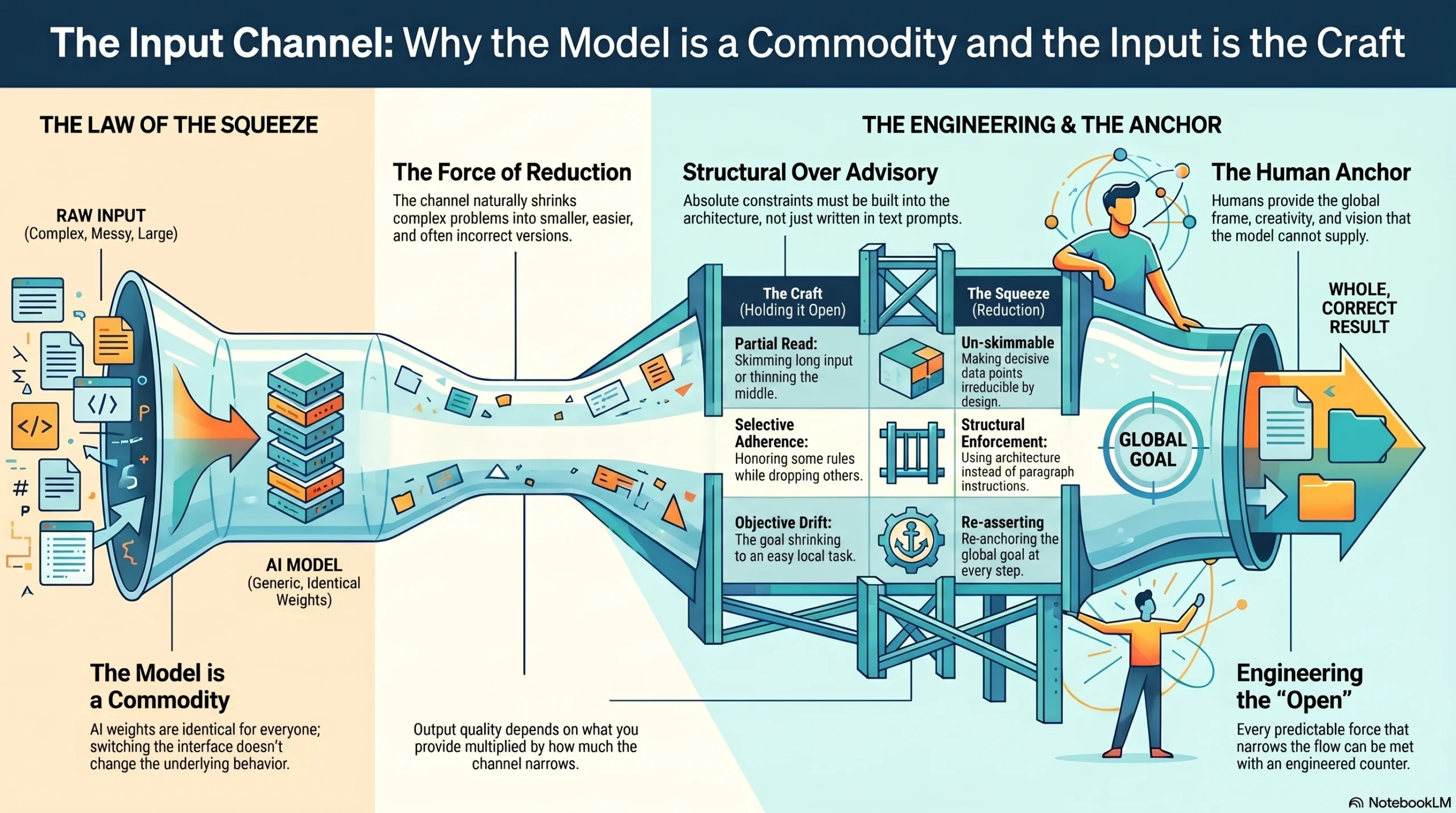
The Model Is a Commodity
The instinct, when an AI gives a weak answer, is to reach for a better model — a bigger one, a newer one, a different vendor. It is almost always the wrong move, for a reason that is easy to state and hard to internalize: the model is a commodity. Everyone has the same one.
It does not matter whether you work in a chat window, a coding editor, an agent framework, a notebook, or a command line; whether the engine carries one brand name or another. The surface changes; the underlying behavior does not. Switching the door does not change the room.
So if the model is identical for everyone, the quality of what you get out of it cannot be explained by the model. It is explained by the two things that actually vary: the input you place in front of it, and the consumption — the predictable biases in how it ingests that input. Both are yours to engineer. Neither is the model.
A perfect input through a pinched channel is still a poor output. “I gave it everything and it still got it wrong” is this law in plain words.
The Same Truth, Everywhere Materials Are Shared
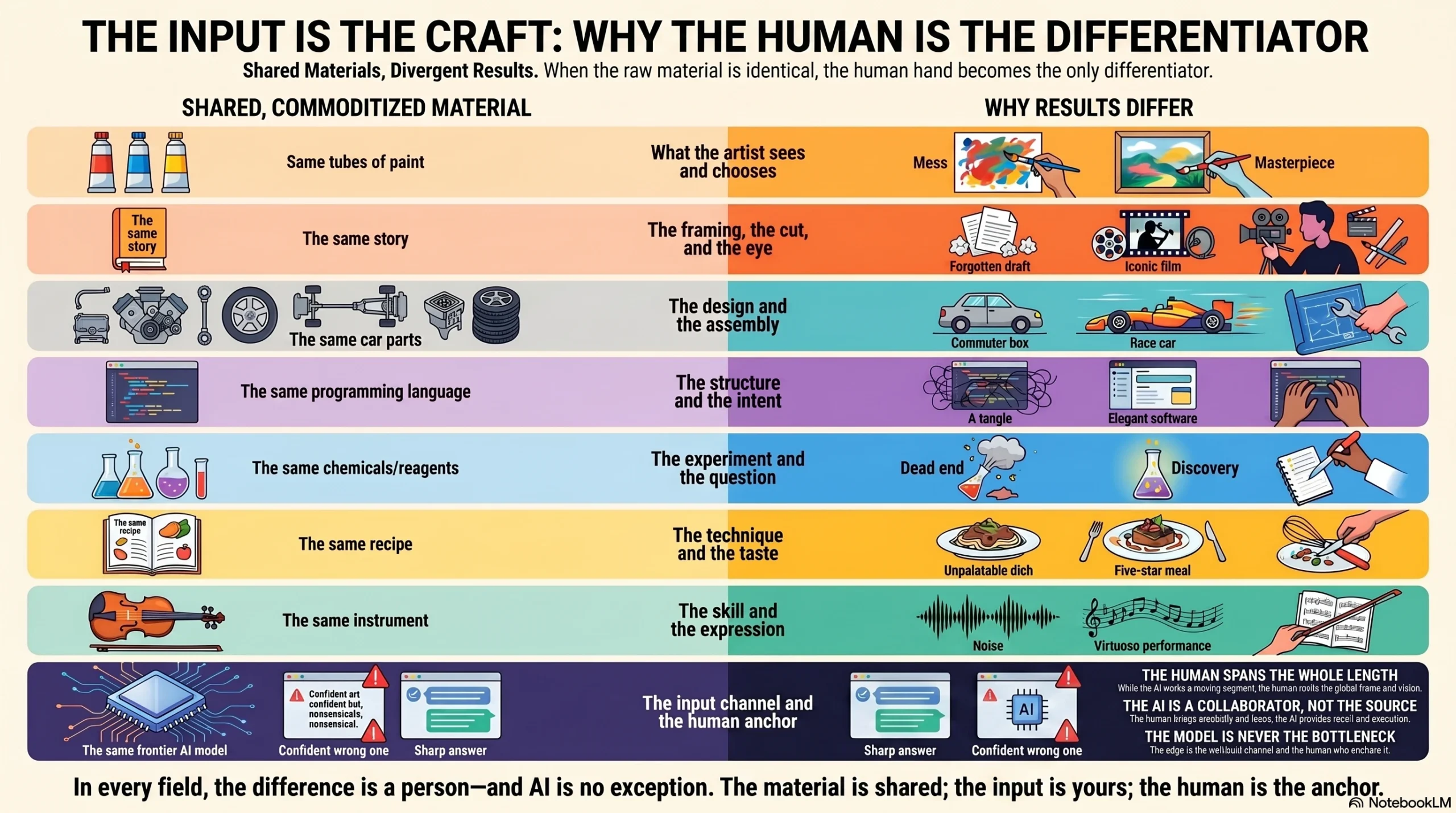
This is not new or strange — it is the oldest pattern in any craft. The raw material is common to everyone; the output is not, because the input and the hand decide it. AI is simply the newest material to follow the rule.
| The shared material — everyone has it | Yet the output differs entirely | Because the difference is… |
|---|---|---|
| The same tubes of paint | Two painters, two completely different paintings | what the artist sees and chooses |
| The same story | Two directors, two completely different films | the framing, the cut, the eye |
| The same car parts | Two builders, a commuter box or a race car | the design and the assembly |
| The same programming language | Two engineers, elegant software or a tangle | the structure and the intent |
| The same chemicals & reagents | Two labs, a discovery or a dead end | the experiment and the question |
| The same frontier AI model | Two people, a sharp answer or a confident wrong one | the input channel — and the human anchoring it |
The paint is a commodity; the painting is the craft. The model is a commodity; the input channel is the craft. Wherever the materials are equal, the input is the entire difference — and the human is the one who supplies it.
The Channel’s Law — Provided vs Landed
Two facts govern the channel, and you need both.
What enters shapes what exits. Place the whole picture in front of the model and it reasons over the whole; place a fragment and it reasons, confidently, over the fragment — and reports the fragment’s answer as if it were the whole answer.
What enters and what lands are not the same quantity. You can place the whole picture in and still get the fragment’s answer, because the channel narrows, samples, skims, reframes, and selectively ignores on the way through. The input you provide and the input that lands differ — and the gap between them is the squeeze. You cannot widen a narrow channel by pouring in more; that gives it more to narrow. The channel is widened by craft.
The Forces and Their Counters
The forces that narrow the flow are not random — which is the good news, because a predictable force can be met by an engineered counter. They are one phenomenon wearing many faces: reduction — the channel shrinking the posed problem to a smaller, easier one and answering that, confidently. This is a catalog we keep adding to, not a fixed count. The method is the pairing itself: name the squeeze, engineer the open.
| The force that squeezes — reduction | What it looks like | The craft that holds it open |
|---|---|---|
| Narrow focus | Decides on a slice of the picture, states it as the whole answer | Show the whole, unranked — no top-N, no verdict-first; let judgment select |
| Partial read | Skims long input, reads head and tail, thins the middle | Make decisive fields un-skimmable — un-reducible by design |
| Framing flip | Reword the question and a buy becomes a sell — no new facts, only new words | Anchor to the data — derive the call from facts, not phrasing |
| Lazy sufficiency | Stops at the first answer that looks done, not the right one | Define done by the objective — proven, not felt |
| Rewrite-over-repair | Regenerates the whole method instead of fixing the few wrong lines | Smallest correct change — repair, don’t regenerate |
| Selective adherence | Honors some written rules and silently drops the rest | Enforce structurally — in the architecture, not a paragraph |
| Objective drift | The global goal shrinks, step by step, to the easy local task | Re-assert the objective — re-anchor before every move |
| Recency capture | The last thing said outranks the first, more important context | Keep the state live & whole — reason over now, not a flattened then |
| … the next face we name | The catalog is open; every collaboration surfaces another | … gets its counter the moment we catch it |
Notice what the right-hand column is not: a better prompt, a longer memory file, a smarter model. It is architecture whose only job is to deliver un-reducible input to a channel that wants to reduce. The craft, not the model, is where the edge lives — and the craft is fully in your hands.
When a Reworded Question Reverses the Answer
One force deserves its own spotlight because it is the most unsettling: the same facts, asked two ways, produce opposite conclusions. Describe a price as “near the lows” and the model leans buy; describe the identical price as “rolling over” and it leans sell — with no new data, only new words.
Why it happens: at its core the model completes the most likely continuation of your text. Your phrasing is part of what it completes — so the wording becomes evidence, sometimes stronger than the data, and the answer drifts toward the direction your sentence already leaned. You think you asked about the situation; you actually asked about your description of it.
When the Goal Quietly Gets Replaced
Over a long collaboration the model understands what you are trying to do — it can even restate your objective back to you — and it will still drift away from it. Not by misunderstanding, but by reduction over time: each step it optimizes the local task you named most recently, and the local tasks slowly pull the work away from the global goal until you look up and a broad instrument has become a narrow gadget. You built the thing you asked for last, not the thing you set out to build.
This is the most expensive force because it is the slowest. The others produce a visibly wrong answer you can catch; drift produces a series of individually reasonable answers that add up to the wrong artifact. The counter is relentless re-anchoring: state the global objective at the start of each step, and check each change against it — not against the local task.
Why Writing the Rules Down Isn’t Enough
The natural response is to write it down — a prompt, a memory file, a playbook, an instructions doc, a skills library, an agent spec. It helps, and it does not solve it, for a reason that is almost circular:
Your prompts, memory, and playbooks are themselves input. So they are consumed with the very same biases they are trying to fix.
The model selectively adheres to the document telling it not to selectively adhere. It skims the playbook that says read everything. It decides which written rules are “relevant right now” and drops the rest — often the one that mattered most. Writing a rule down moves it from absent to present but optionally consumed. That is progress, not enforcement.
Written context is valuable — but the constraints that absolutely must hold cannot be advisory. They have to be structural: enforced by how the system is built, not by whether the model chooses to honor a paragraph.
The Human Is the Anchor
If the channel narrows, reframes, and drifts — and if writing the rules down doesn’t fully stop it — then something outside the channel has to hold the line. That is the human. Not as a fallback. As the anchor — spanning the entire length of the flow while the model works a moving segment of it.
This is collaboration, not delegation. The AI is extraordinary at recall, computation, breadth of pattern, and holding more detail in view than a person can. The human is the one with the vision, the creativity, the global frame, and the stake. Together they are a complete decision-maker. The AI alone narrows; the human alone is slow. The anchor stays human.
The Same Channel, Any Field
Trading exposes the channel fastest — a reworded question becomes a buy instead of a sell, a partial read misses the decisive figure, and the cost lands in minutes. But trading is only the canary. The channel, its forces, and its counters are identical wherever a person collaborates with an AI on a decision that matters.
| Field | The input that should land | The squeeze that pinches it |
|---|---|---|
| Software engineering | The whole module, its callers, the real error, the existing design | Skims the file; rewrites the method instead of fixing the line |
| Research / analysis | The full dataset, every column, the true distribution | Reads a sample, decides on it, states it as the whole |
| Operations / monitoring | The complete live state across all systems | Narrows to the alert in front of it; misses the correlated cause |
| Writing / knowledge work | The full source, the actual brief, the real audience | Reframes to an easier brief; settles at the first draft |
| Markets / trading | The whole board, every window, the live tape | A reworded question flips the call to its opposite |
| … any expert + AI decision | The global objective + the live, complete context | Drifts from the goal; over-weights the last instruction |
Different surfaces, different vendors, different fields — one channel. The model is the same commodity everywhere; the forces of reduction travel with it everywhere; everywhere the counter is the same: engineer the input and its consumption, and keep a human anchored on the whole. The Discovery Factory generalized a method across fields. This generalizes the failure mode and its remedy across every place an AI is put to work.
A Companion Piece
This piece is about collaborating with an AI — the input you hand it and how it gets consumed. Its companion is about building a predictive system: how to discover signals, validate them cheaply, and earn the trust to act on them.
What enters the channel is yours. How much survives the squeeze is engineered. And a human spans the whole length — because creativity, vision, and the global frame are the human’s to hold.
Input shapes output. Reduction decides what lands. The human decides what matters.