Capturing the hidden beauty of the universe — from faint nebulae and distant galaxies to the sweeping arc of the Milky Way. Hours of photon collection, precision tracking, and careful processing reveal celestial structures invisible to the naked eye.
Astrophotography is the art and science of capturing images of celestial objects and the night sky. Unlike visual observation through a telescope, astrophotography reveals details and colors invisible to the human eye by collecting photons of light over extended periods — often minutes or hours. This technique transforms faint, distant objects like nebulae, galaxies, and star clusters into vivid, detailed images that showcase the hidden beauty of our universe.
The magic happens because camera sensors can accumulate light over time, building up signal from objects millions or even billions of light-years away. What appears as a faint smudge or is completely invisible to our eyes becomes a stunning portrait of cosmic structure, complete with delicate filaments, vibrant hydrogen emissions, and distant background galaxies.
🔭
Deep Sky Imaging
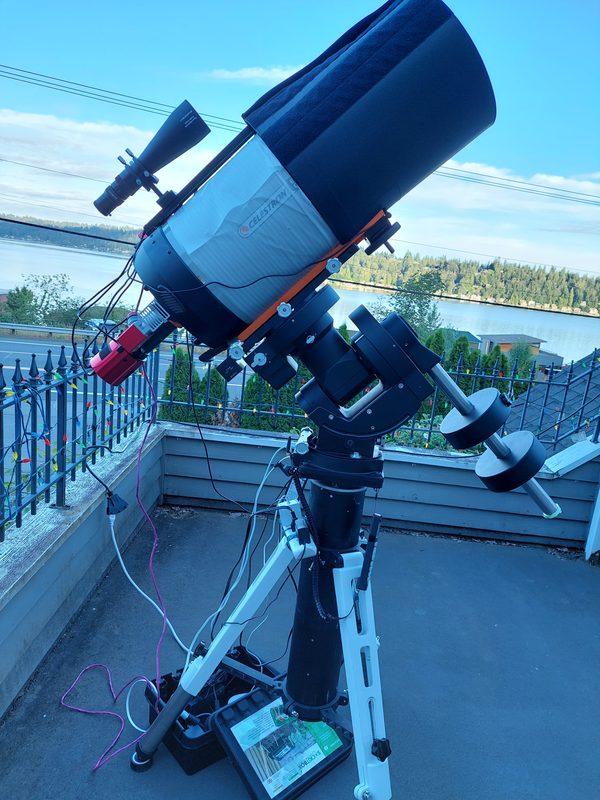
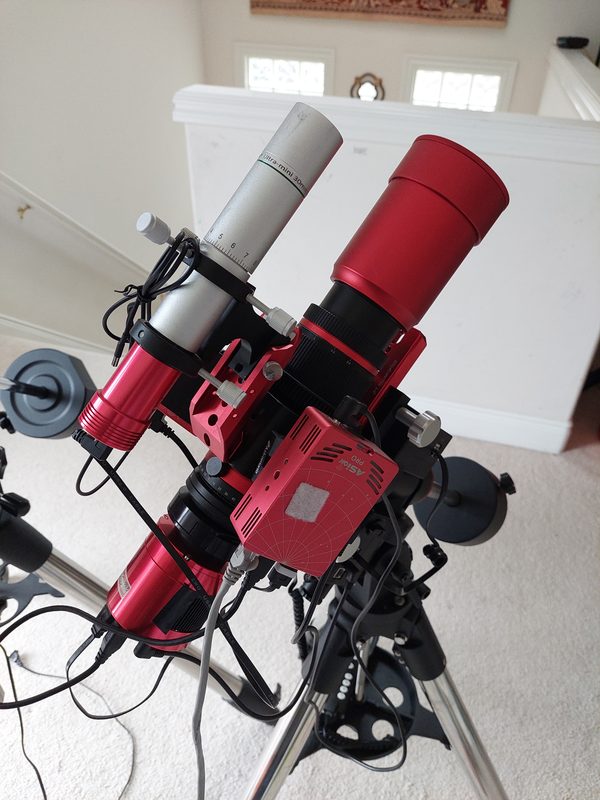
Targeted long-exposure imaging of specific celestial objects — nebulae, galaxies, star clusters, and supernova remnants. Using the Celestron EdgeHD 11″ for high-magnification targets and the William Optics Redcat 51 for wide-field nebulae, each image represents 3–6 hours of total exposure time captured across multiple nights, then stacked and processed to reveal hidden structure and color.
🌌
Milky Way & Nightscape
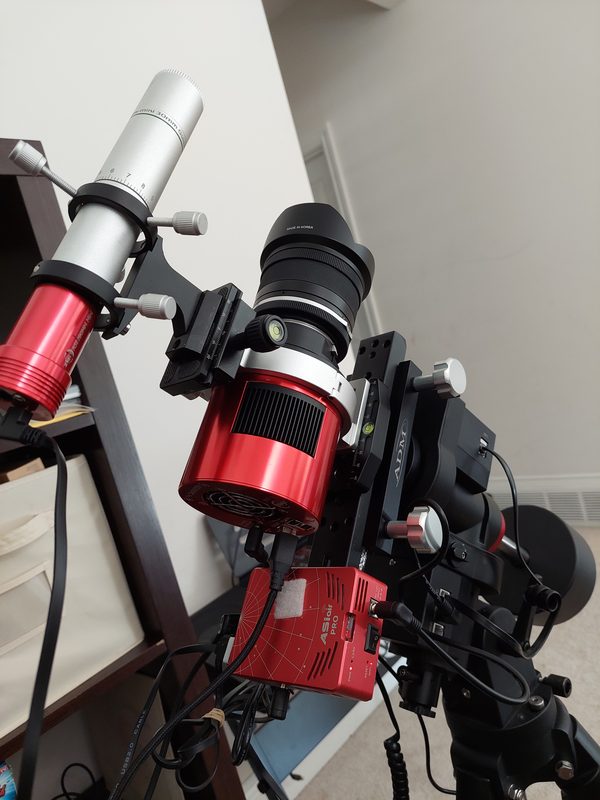
Ultra-wide-field photography capturing the sweeping arc of our galaxy against dramatic landscapes. Using the ZWO ASI2600MC Pro paired with a Rokinon 14mm f/2.8 ultra-wide lens on the portable iOptron GEM28 mount, this setup is optimized for travel to dark-sky sites where the Milky Way core is visible in all its glory.
Unlike deep-sky imaging where narrowband filters can cut through light pollution, Milky Way photography demands genuinely dark skies (Bortle 3–4). The fast f/2.8 aperture and 14mm ultra-wide field of view capture the entire galactic core in a single frame, with tracked exposures of 30–120 seconds keeping stars pinpoint sharp across the field.
By the Numbers
3–6h
Exposure per Image
Dozens of sub-frames stacked to build signal from objects millions of light-years away
26 MP
Cooled CMOS Sensor
ZWO ASI2600MC Pro — thermoelectric cooling reduces noise during hours-long sessions
2800mm
Maximum Focal Length
Celestron EdgeHD 11″ reaches distant galaxies and planetary nebulae at high magnification
14mm
Widest Field of View
Rokinon ultra-wide captures the full Milky Way arc and sweeping nightscapes
3
Optical Instruments
EdgeHD 11″, Redcat 51, and Rokinon 14mm — covering every target scale from galaxies to the galactic core
10×
SNR Improvement
Stacking 100 calibrated frames improves signal-to-noise ratio by a factor of 10
Equipment
Setup 1 — Deep Sky Rig
High-magnification and wide-field deep-sky imaging from the home observatory, built around the heavy-duty iOptron CEM120 mount.
Celestron EdgeHD 11″ on iOptron CEM120Redcat 51 + ASI2600MC Pro + ASIAIR Pro
🔭
Telescopes
Celestron EdgeHD 11″ — An 11-inch Schmidt-Cassegrain with ~2800mm focal length (1960mm with 0.7× reducer). Ideal for small, distant galaxies and planetary nebulae requiring high magnification.
William Optics Redcat 51 — A compact 51mm f/4.9 refractor with ~250mm focal length. Perfect for large nebulae, star clusters, and wide galactic regions.
⚙️
Mount
iOptron CEM120 — A precision center-balanced equatorial mount for the home observatory. Carries heavy payloads (the EdgeHD 11″ weighs 28 lbs) while maintaining arc-second tracking accuracy over hours of imaging. The backbone of the deep-sky rig.
Setup 2 — Milky Way & Travel Rig
Lightweight, portable setup for dark-sky expeditions and Milky Way imaging. Fits in a carry-on bag.
Rokinon 14mm f/2.8 Ultra-Wide Lens
🌌
Lens
Rokinon 14mm f/2.8 — An ultra-wide manual-focus lens with built-in lens hood. The fast f/2.8 aperture captures the galactic core in short tracked exposures (30–120s), and the 14mm field of view fits the entire Milky Way arc in a single frame. UMC coated with low distortion — purpose-built for nightscape photography.
⚙️
Mount
iOptron GEM28 — A lightweight, portable German equatorial mount purpose-built for travel. At just 11 lbs, it easily carries the ASI2600MC Pro + Rokinon 14mm or Redcat 51 while providing accurate tracking for dark-sky expeditions and Milky Way sessions away from city lights.
Shared Equipment
Camera, controller, and accessories used across both deep-sky and Milky Way setups.
📷
Camera
ZWO ASI2600MC Pro — A cooled, one-shot-color CMOS camera with 26 megapixels. The thermoelectric cooling system reduces thermal noise during long exposures, and its high quantum efficiency captures more photons from faint objects. Used across all setups — deep sky and Milky Way.
🔧
Accessories
Radian Triad Ultra 2″ filter — A tri-band narrowband filter isolating hydrogen-alpha, oxygen-III, and sulfur-II emissions. Cuts through light pollution and dramatically enhances nebula contrast.
Celestron 0.7× Reducer — Reduces the EdgeHD focal length to ~1960mm and increases the field of view for larger targets.
ZWO ASIAIR Pro — A dedicated imaging computer that controls the camera, mount, and focuser, running entire sessions autonomously.
ZWO EAF — Electronic autofocuser that maintains critical focus throughout the night as temperatures shift.
From Photons to Final Image
🎯Planning Target, moon, weather
→
🧭Alignment Polar & star align
→
📸Acquisition Light, dark, flat, bias
→
📚Stacking Calibrate, align, integrate
→
🎨Processing Stretch, extract, sharpen
→
🖼️Final Image Gallery & print ready
📸
Acquisition
Instead of one long exposure, dozens or hundreds of shorter sub-frames (1–5 minutes each) are captured, totaling 3–6 hours of integration time per target — often across multiple nights. Calibration frames (darks, flats, and bias) are also captured to map and remove sensor artifacts, vignetting, and optical imperfections.
For Milky Way work, shorter tracked exposures of 30–120 seconds at f/2.8 capture the broadband starlight and galactic dust lanes, with 20–40 frames stacked for clean results.
📚
Stacking & Calibration
Each light frame is calibrated using dark, flat, and bias frames, then aligned with sub-pixel precision using star positions. All frames are mathematically combined — typically median or weighted average — into a single master image with dramatically lower noise than any individual exposure.
🎨
Post-Processing
Raw stacked images are extremely dim — most data is compressed near black. Using PixInsight, non-linear stretches reveal hidden nebulosity and galaxy structure. Background extraction removes light pollution gradients, color calibration balances the channels, and detail enhancement sharpens fine structures. Adobe Photoshop handles final refinements and artistic presentation.
Light & Spectrum
Hα
Hydrogen-Alpha
656nm — deep red. The dominant emission in most nebulae, tracing ionized hydrogen gas
OIII
Oxygen-III
496–501nm — blue-green. Common in planetary nebulae and supernova remnants
SII
Sulfur-II
672nm — deep red. Traces shock fronts and dense regions in emission nebulae
Narrowband Imaging
The Radian Triad Ultra filter isolates these three emission lines, blocking broadband light pollution and enabling detailed nebula imaging even under Bortle 5–7 suburban skies. Many processed images use the “Hubble Palette” (SII→Red, Hα→Green, OIII→Blue) to separate overlapping emissions and reveal structural detail.
The Light Pollution Challenge
Light pollution is the single biggest challenge for astrophotographers, especially those imaging from suburban locations. Artificial light from cities scatters in the atmosphere, creating a bright background glow that drowns out faint celestial objects and limits how deep you can image.
Solutions include narrowband filters that block broadband pollution while passing nebula emissions, longer total integration time to overpower the noise floor, careful background extraction during processing, and traveling to dark sites (Bortle 3–4) for dramatically cleaner data — especially for Milky Way photography where narrowband filters don’t help with broadband starlight.
Even under moderately light-polluted skies, with proper technique and sufficient exposure time, stunning deep-sky images are absolutely achievable — as demonstrated in the gallery.
Browse the full collection of deep-sky and Milky Way images. Every image represents hours of capture time, precision equipment operation, and careful processing — all in pursuit of revealing the incredible structures hiding in the darkness between the stars.
Full acquisition details for every image — exposure times, filters, calibration frame counts, equipment used, and processing notes. AstroBin is the astrophotography community’s platform for sharing images with complete technical metadata.